Sunday, June 9, 2013

We have at least one formel and one tiercel

The eyasses are now old enough for their gender to be differentiated by the size of their tarsal bones.  John Blakeman analyzed the structure of the tarsals (ankles in humans) of the two oldest in the image below with #2 in front and #1 behind.

      Kay Meng

He believes,
"#2 is clearly a tiercel, and #1 a formel. The photo showing both of the legs together is definitive."

A close-up image of #1's feet shows the thick, dense ankles characteristic of a formel (female) who is always larger than the tiercel (male).  The tiercel has thinner ankles.

            Kay Meng


Though the two oldest hatched on the same day and thus are known as "the twins," nine hours separates them.  The one that now has the most head feathers growing through the fluff...

          Kay Meng

... is probably the oldest, thus #1 and a formel.

Here's another view of her large ankles.  She also has those broad shoulders we see in Mom.

                                    Kay Meng


Kay took these pictures on June 7 as the torrential downpour from tropical storm Andrea was moving into the Philadelphia area.  This eyass was looking skywards hoping a parent would soon arrive with food.

          Kay Meng


As always, the eyasses were fascinated by what was going on behind their window.

                                     Kay Meng


The more interested they become, the farther round they twist their heads in curiosity....

          Kay Meng


... and then start to move closer.

          Kay Meng


The youngest, #3, stayed huddled in its corner, but watched everything with equal curiosity.  The three day difference in its age from the other two is noticeable in the lack of feathers on its head, still mostly fluff.

          Kay Meng


Over the past week, the tireless hawkstalkers have been out there in sun and rain capturing wonderful images of all the action at the nest.


June 2
T2 is wreaking havoc on the local squirrel population.  He brings at least one a day to feed his eyasses.

          Carolyn Sutton


June 3
Mom keeps the greenery fresh on the nest with daily deliveries.

          Kevin Vaughan


This may be #2, the tiercel.  His shoulders are not as pronounced as #1, and he has a narrower build.  The chestnut peach coloring is now very prominent on their chests.

          Carolyn Sutton


Rat was on the menu today, and this eyass was doing its best to stuff down the final morsel to the astonishment if not concern of its siblings.

          Scott Kemper


Is this sibling assistance or sibling greed?

          Scott Kemper


The matter was resolved with a huge gulp!

          Scott Kemper


June 4
Here are #1 and #2 showing that most of their white chest fluff has been replaced with peach feathers.  It's probably #1 on the right with slightly more peach and head feathers showing.

           Valerie Russell Hutton


Meanwhile, #3 (left) still has very little peach showing

          Kevin Vaughan


June 5
The wing feathers continue to grow in strongly...

          Kevin Vaughan


... and though most of the wingercizing is still done facing the window, they are moving closer to the front of the nest.

          Kevin Vaughan


June 6
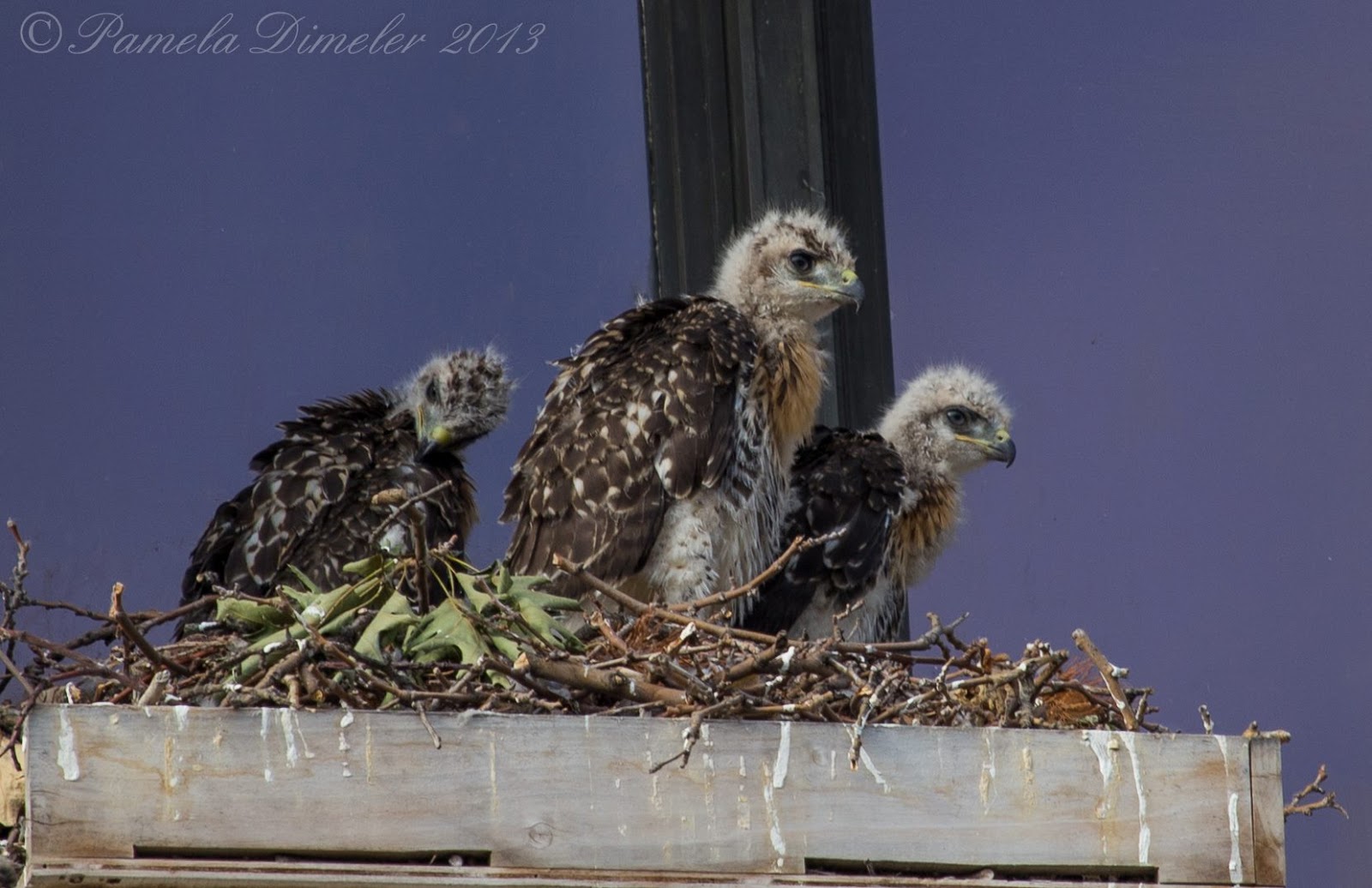
Here is one of the relatively few images of all three eyasses standing up together.  When one or more is lying down at the back of the nest they are invisible from the ground.  #3 (right) still has markedly more white head fluff than the other two.
          Pamela Dimeler


#3 is entering the Baby Dracula stage.

          Pamela Dimeler


Its wings are impressive when unfurled.

          Pamela Dimeler


This beautiful picture shows amazing detail of the peach feathers replacing the chest fluff, as well as the gold eye color of eyasses, in contrast to the darker eyes of the haggards.

              Pamela Dimeler


Though the eyasses are now perfectly capable of feeding themselves, Mom continues to feed them when she is on the nest.

          Pamela Dimeler


She is also conscientious about removing leftovers from the nest.

          Pamela Dimeler


This meal appeared to be a fledgling - possibly a pigeon.

                             Pamela Dimeler


The big excitement on Thursday was when the first eyass ledged.  This is when an eyass steps down off the nest onto the ledge alongside upon which the nest rests.  The ledge runs several feet along the windows of the Board Room.

Much to the hawkwatchers' surprise, this important milestone was reached first by #3!  It is debatable whether #3 actually intended to jump off the nest.  Observers noted that it appeared more a loss of balance during enthusiastic preening.

Pamela Raitt happened to be down on Winter Street when this occurred, and her quick reaction caught the moment when #3 plopped down onto the ledge, watched in consternation by its older siblings.  After a moment or two it hopped right back into the nest.

                  Pamela Raitt


June 7
This was the day of non-stop rain from tropical storm Andrea. The eyasses battened down their hatches and did their best to stay dry...

          Della Micah


... but as the day progressed, they got wetter and wetter.  Luckily, there was little wind and the temperature was warm.

          Della Micah


#3 proved that Thursday's accidental ledging was perhaps not so accidental.  Here it is on Friday confidently exiting stage left...

          Pamela Dimeler


... watched in astonishment? consternation? envy? by its siblings.

          Pamela Raitt


Then a second eyass made the leap leaving only one on the nest.

          Pamela Raitt


Eventually, everyone made it back safely.

          Pamela Dimeler


June 8
Saturday was a classic day after the storm with sun and blue skies.  The eyasses enjoyed catching some of those morning rays.

            Debi Rabin


Utter chaos ensued when Mom arrived with food (rat) ...

           Kevin Vaughan


... and then it got REALLY chaotic!

           Kevin Vaughan


Eventually, everyone got fed - and fed well - judging by this eyass's enormously stuffed crop.

           Kevin Vaughan


Mom appears to be keeping a watchful eye on the situation...

           Kevin Vaughan


... and then flew out with the leftovers of the rat (hard to believe that eyass left anything behind!).

           Debi Rabin


           Debi Rabin


Later in the afternoon, with lunch (squirrel) lying graphically to the side, it was time once again to contemplate the mysteries of ledging.

          Della Micah


The food service became even more graphic when dinner arrived before lunch got cleaned up.

          Della Micah


To finish, here are some beautiful portraits of the haggards taken this week by five of the talented photographers who generously allow me to use their images.


Mom

           Nick Cinciruk


                                             Kevin Vaughan


           Scott Kemper


T2

     Pamela Dimeler


           Debi Rabin


           Scott Kemper


Monday, June 3, 2013

Sssteamy hot in Philadelphia

We are in the midst of a heatwave in Philadelphia with several days now of temperatures in the 90s.  The eyasses definitely feel the heat, and pant to keep cool.

          Kay Meng


There are no head feathers yet (taken on May 29) - just fluff - which indicates they are nowhere near ready to fledge.  By the time this eyass fledges, there will be no head fluff at all.

          Kay Meng


In addition to panting, they sit back and hold up their (huge!) feet for maximum cooling.

          Kay Meng


Today (June 2) Mom tried to stay cool by letting her wings droop down and away from her body.

          Della Micah

I asked John Blakeman if this extreme heat causes distress for the eyasses, and whether their later hatching this year which will take them well into June's summer heat before they fledge will be problematic.

John Blakeman's reply:

"Take no concern for the excessive heat. Red-tails experience much greater heat in the deserts of the West. They are uncomfortable, but can handle it. In fact, they turn down their metabolism and body temperature, thereby requiring less food. But most of the food, now, of course, will be used [for the eyasses] to grow new feathers and muscles.
And the same for the summer heat. A matter of no real concern. The later fledge time changes really nothing. As before, all will be well."


Kay's pictures from May 29 show some important developmental milestones.  The two older eyasses show the beginnings of the beautiful chestnut peach coloring on their chests...

                         Kay Meng


... and their tail feathers - black and brown barred - are clearly visible.

          Kay Meng


The eyasses are completely unfazed by people photographing or watching them from behind their window.  More than anything, they are curious to see what's going on back there.  This eyass inched as close as it could to the glass...

          Kay Meng


... and this one stepped across the nest as Kay changed the lens, watching her every move.

               Kay Meng


Mom flew in several times, mostly staying only for a minute or so.  She too was unbothered by visitors near the nest.

                                      Kay Meng


On one of her visits, she started to preen the eyasses, stripping out bits of fluff.  They looked about as uncomfortable with this attention as any child would when a parent is fixing its appearance in some way!

                                     Kay Meng


This eyass couldn't completely swallow down the huge chunk of bird it had gobbled, leaving a morsel hanging out of its beak.

                      Kay Meng


Their growth rate is phenomenal.  It's hard to believe that only four weeks ago they looked like this!

          JB Mayberry


Over the past week, their feathers have really started to grow through the fluff, and their appearance seems to change daily.

May 26
Just a few feathers poking through at the edges of the wings.

          Scott Kemper

          Carolyn Sutton

          Carolyn Sutton


May 28
In addition to many more feathers on the wings, this eyass's bulging crop shows it had just dined extremely well.

           Kevin Vaughan


The all-important flight feathers along the edge of the wings are getting longer.

           Kevin Vaughan


May 29
Entering the Baby Vulture phase.

           Kevin Vaughan


May 30
Seriously impressive wing feathers now.

          Carolyn Sutton


May 31
Their bodies are now almost completely feathered, but their heads remain covered in fluff.

           Kevin Vaughan


Another important stage they reached in the past week is vigorous wing flapping - wingercizing! - which is essential to develop the muscular coordination and strength needed for flying.  At first, most of the flapping is done facing into the window with their backs to the street.

          Carolyn Sutton

           Debi Rabin


As they become stronger and more confident, they start to turn out.

           Kevin Vaughan


When they face forward to flap with their backs to the window, they are closer to the time when they will start to flap-jump off the nest and onto the ledge that runs alongside.


            Pamela Dimeler


           Kevin Vaughan


Here's a timeline from May 22 - June 2 that shows many of the daily events on the nest.

May 22
The family still fits fairly comfortably on the nest.

          Kathy Brophy Holmes


May 23
No feathers yet.

           Pamela Raitt


May 25
Two days later, and what a change with feathers clearly showing!  #3 in the middle had managed to snag a huge chunk of food, and was having difficulty swallowing it down.  Mom is always ready for these occurrences, and if necessary, will pull the food out gently, and start over.

        Tess Cook


May 26
The eyasses show increasing curiosity about the world down below...

           Scott Kemper


... and move closer to the edge of the nest.

          Scott Kemper


May 27
Family time on the nest.

         Ari Rosenthal


A lovely moment caught by Ari Rosenthal as T2 carefully feeds one of his eyasses.

           Ari Rosenthal


May 28
Everyone has feathers now!

          Della Micah


It started to rain that morning, and after breakfast the eyasses huddled closer and closer to stay warm.

          Della Micah


Later that day, Kevin caught these amazing images of Mom landing on the nest, showing the aerodynamic control she has to put on the brakes and land softly beside the eyasses.  What cannot be conveyed is the sheer speed of her approach when it seems that she must crash into the window.

           Kevin Vaughan


                                 Kevin Vaughan


May 29
T2 has everyone lined up nicely waiting to get fed.

           Kevin Vaughan


Then Mom flew in with greenery...

           Kevin Vaughan


... and the food service must have slowed down, so this eyass took matters into its own beak.

           Kevin Vaughan


May 30
An alternative to waiting your turn is to grab from your sibling.  Mom does not look pleased!

          Pamela Dimeler


Standing tall to look out...

            Kevin Vaughan


... and leaning forward.

          Pamela Dimeler


May 31
Not much body fluff left now.  #3 in the middle still has fewer feathers, and a slightly smaller head.

            Kevin Vaughan


Because they spend so much time sitting down, the down on the backs of their legs has worn off.

            Kevin Vaughan


The chestnut peach coloring on their chests is spreading.

           Kevin Vaughan


June 2
Today, the first traces of head feathers are showing.

          Debi Rabin


Each days ends with Mom settling on the nest, keeping watch as night falls.

May 28
           Kathy Brophy Holmes


May 29

           Pamela Raitt


June 2
         Della Micah