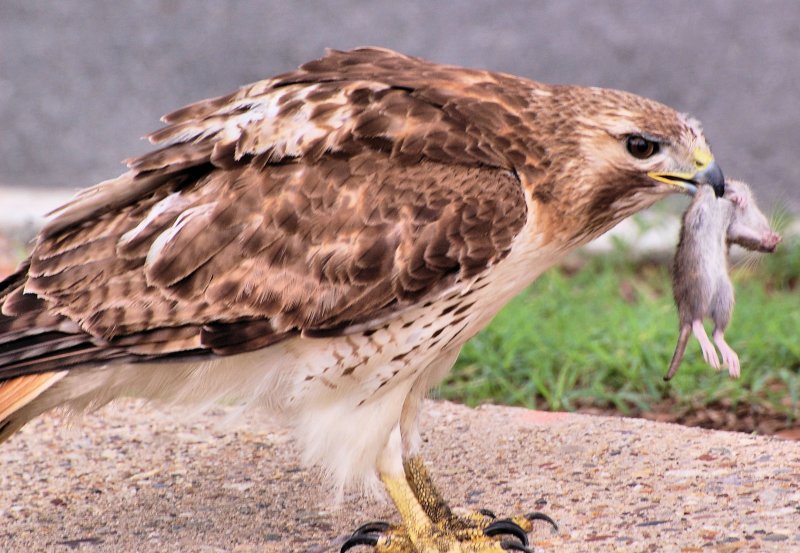
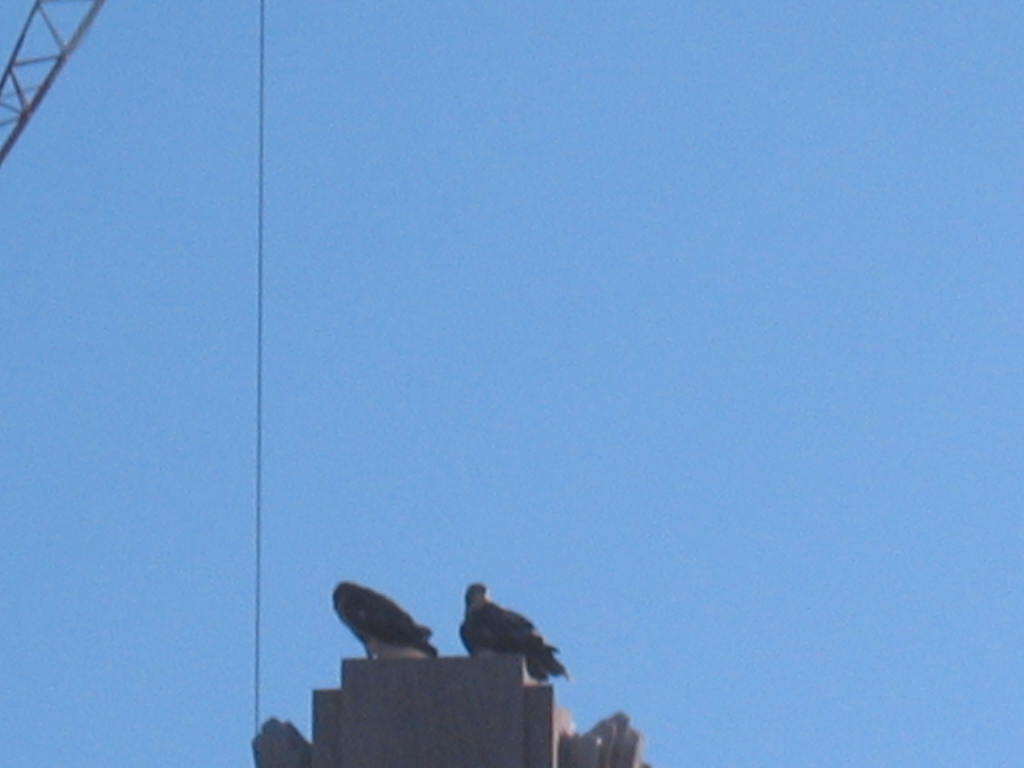
Here is his latest commentary on how hawks locate, catch and kill their prey, illustrated with some of Kay Meng's images from last year and this of the Franklin Institute haggards.
"Those fortunate enough to intimately watch the activities of haggards and eyasses at red-tailed hawk nests such as at The Franklin Institute see much that others never get to experience. I thank the Institute for allowing all of us to be so keenly entranced with this remarkable spectacle.
I’ve been studying red-tailed hawks across the entire continent, from Alaska to Maine for 40 years, focusing primarily on the birds in my native northern Ohio. I’ve watched dozens of nests, and except for a few in northern Nevada, where I could look down into the cliff-ledge nests from above, I’ve never been able to see all that I’ve seen now for two years at The Franklin Institute. My great thanks!
But there is one facet of red-tail life that has not been observed at The Institute nest. It’s extremely important, and to understand this regal bird, this facet of its life should be understood and pondered. I believe I know it better than most raptor biologists because I’m a master falconer, and I hunt with red-tailed hawks, so I get to see what I’m about to describe first hand – up close and personal.

The topic is how the hawks find, capture, kill, and eat their food. It’s not like a pigeon finding grain or seeds, or a robin pulling a worm from the soil. It’s far more complex and interesting; if not gory and startling. This may not be for the squeamish. We are dealing with a predator, a species whose life depends upon the slaying of other lives. A very serious matter, both ecologically and morally.
A more exhaustive deliberation on these topics should be the themes of several chapters in an intended book on red-tailed hawks. But in the shared joy of The Franklin Institute fledglings, I’ll focus on what these young birds must learn in the next six weeks or so—how to hunt and kill, efficiently and frequently. Should these skills fail, the now-healthy eyasses will starve and die this summer, a fate that awaits the majority of fledged red-tail eyasses. This is a serious matter, much more so than merely learning to fly and land.
First, let me summarize the hunting and killing skills and protocols of the haggards. They are profound killing machines, resulting once again in the production of three fledged eyasses, which are a result of the haggards’ applied hunting and killing skills. Our three eyasses never once went to sleep hungry. They grew and thrived on ample and diverse food brought to them by the haggards, but mostly by the tiercel. He was a father supreme, in every respect, the Great Provider for both his young eyasses and his incubating and eyass-tending formel. Let’s start with just how the tiercel was so able to provide food for his large family.

To capture prey, the hawk must first spot it, using its telescopic eyesight. That’s pretty obvious. But a more subtle, but even more crucial factor must first come into play. The hawk can’t spot prey animals that aren’t there. The first big factor is for the hawk to Be There. Where? Where prey are likely to be seen.

Our vaunted tiercel did not spend the winter and spring wandering randomly around his portion of Philadelphia. Quite the opposite. His flying traverses above the Parkway trees and buildings were anything but random. When we see a red-tail regally coursing overhead, we have no idea what he’s thinking, or where he’s going. To us, he’s just flying around up there. Looks pretty relaxed and casual to us, something we’d all like to be able to do.
Many a time I’ve imagined myself as a red-tail floating on set wings above my rural landscape. What wonderful views I could have, how much fun it would be to set my wings against the winds and get caught up in a warm thermal draft over a nearby soybean field. In just a few minutes, without a single wing beat, I’d be at 3000 feet, peering down telescopically at everything below. I feel sorry for those who have never watched a red-tail do all of this, as they’ve never personally entertained such dreams of emulating the hawk’s soaring flight. All of us need to engage in such fantasies from time to time. They allow is to connect so personally with these regal birds.
So, no - red-tails circling high above, or flying just above the trees in a straight line, are not randomly wandering. Each of their movements are somewhat deliberate, performed within a guiding mental framework of experience and desire.

When red-tails are soaring, they are never hunting. They soar because they and their eyasses are fed and sated. Although it’s unacceptably anthropomorphic to say this, I actually believe that red-tails just love to soar and circle as we would ourselves, were we given such powers. Hanging up there so effortlessly and wheeling so balletically must be pleasurable to these birds. They are content, secure, and hopeful in these elevated flights, if not downright ecstatic.
But red-tails, and all other hawks, are visual creatures, seeing things that few other animals can or do. They are able to see broad, but detailed, wide-angle fields of view just as we do—and very few animals can do this. We have a giant portion of our brain, the occipital lobe at the back of the cranium, dedicated to the interpretation of the massive signals coming into the brain from our dense light-sensing cells on the retina. Many animals are almost blind, lacking the ability to make sense of all the photos impinging on the retinal surface. Their brains focus only on a few, central details. We humans see better than most other animals.
And so do red-tails. They see the broad, wide landscape, perhaps almost as well as we do, although their brains are minute compared to ours. (That’s a problem for comparative anatomy and physiology, which I’m not competent to expound upon.) But here’s where red-tails and other similar hawks differ from us. As the hawk scans the sky and landscape, its brain instantly recognizes what’s most important - the distant appearance of a prey animal. A soaring peregrine falcon can spot a distant prey bird, perhaps a pigeon or duck, from thousands of meters away. A red-tail’s eyesight is just as good as a peregrine’s, but it’s searching for food it prefers, primarily prey on the ground, mice, rats, and squirrels. (Pigeons are an entirely other matter, which I’ll address later.)

As our tiercel flew all around The Franklin Institute last year, it was always searching for food to capture, kill, and eat. Here’s the important consideration of all of this apparently random flying around. First, again, it’s not so random. There is a daily pattern to red-tail flights. That’s why it would have been so fine to get a radio beeper (transmitter) on either of the haggards so their whereabouts 24/7 could have been plotted. When this is done (I’ve done it only by diligent visual plotting using a binoculars and a car, tagging behind a red-tail’s daily flights in my flat Ohio row-crop landscapes), red-tails are found to have a somewhat narrow schedule of daily activities, among which is a lot of flying from frequent perch to frequent perch.
Red-tails usually spend much more time perched than flying. To the unknowing, they are regarded as lazy sit-abouts failing to attend to important matters—living as many of us do too often (or wish we could, as on vacation). Not so, however. Get your binoculars on a sitting red-tail and look closely at what he’s doing with his head. Except when preening (usually in the morning—another topic altogether), he’s moving his eyes in every direction. He may have his foot propped up and appears to be at utter ease. Physically, he is. But mentally, he’s taking in everything he can see, focusing for an instant to the left, then to the right, then down below, then behind, then back in front. All the while, he’s watching for two things; first, the presence of any intruding red-tail or other hawk or unwelcome bird or animal. But more importantly, he’s looking for any prey animals, any animal in his giant field of vision that could become his next meal. His brain is exquisitely programmed to instantly zoom in on and focus on any potential prey animal that appears in his field of vision.

And every time he sees any such animal, even if it’s a fractional glimpse of a rat’s tail, a split-second leap of a one-ounce vole between two distant grass clumps, even the hop of a grasshopper one hundred yards away, he sees and records the image in his brain. His existence depends on these innate skills. He must quickly learn and remember where prey can be seen.
So as our Parkway red-tails have flow around their Philadelphia neighborhood in the last year, in all seasons and weather conditions, they have been diligently recording just where they’ve seen potential prey. That’s where they are going to go when they want to hunt, when they or their eyasses are hungry. They have learned to cogently read the entire landscape the occupy, and know exactly where the next meal’s most likely to be found.
That’s the first, and in fact, most important part of this story. The hawk has to put himself where he has the highest chance of winning, of seeing and capturing a prey animal. He’s got to get the odds in his favor. He, as the eyassses will in the coming weeks, learned that car parking lots, for example, just never have any huntable prey. Don’t waste time sitting on a utility pole looking down amongst all those iron heaps for a warm, juicy fresh meal. Wrong place. Fly over to where prey were frequently seen and caught, to happy hunting grounds, as it were.
Fortunately, there are apparently lots of good hunting areas for our red-tails on the Parkway. The newly-fledged eyasses will now have to learn those lessons themselves, using their still-weak flight powers, powerful eyes, and developing mental abilities.
This is getting a bit long here, so I’ll return later with more of this big story, how red-tail hawks hunt and kill."
-- John Blakeman




 Posts
Posts


