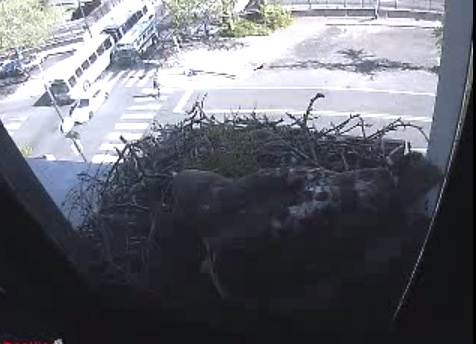
Sunday, May 5, 2013

More on the hatching of Egg #3

On Friday evening, the third egg remained stubbornly whole...

          Tess Cook


... despite what seemed to be a large pip that had first appeared on Wednesday evening.

          Della Micah


What hawk watchers had thought was a crack around the egg...

          Pamela Raitt


... turned out to be a half-shell caught on the end of egg #3.  Here it is lying beside the unhatched egg.

          Julie Steiner


It was such a happy surprise Saturday morning to see the third eyass out of the egg and peeking over its shell.

          Della Micah


T2 brought in a breakfast rat...

          Pamela Raitt


... and for a moment it looked like he might be up to his old tricks of taking the rat away again...

          Della Micah


... but Mom moved in smartly and put an end to that.

          Della Micah


The two oldest eyasses are getting stronger by the minute, and have already engaged in some sibling squabbling.

          Pamela Raitt


Sated with rat, they fell into a pile of fluff to sleep it off, and their parents took a break away from the nest.  One eyass is still awake, but barely.

           JB Mayberry


The remains of the rat lay beside them ready for the next meal.

           JB Mayberry


You can be sure that Mom had the nest in her sight the whole time she was away.  Here she is in "her" tree, just across from the nest on the Benjamin Franklin Parkway.

      Al Wilson


As large and powerful as she is, she is lighter than she looks, and can perch in the topmost twigs of this large tree without them bending or giving way, allowing her to be at the same level as the nest

          Al Wilson


T2 seems to believe one can never have enough sticks on the nest...

      Kevin Vaughan


... and continues to make frequent deliveries.

      Kevin Vaughan


T2 is also definitely stepping up to the plate on food delivery.

      Kevin Vaughan


He has not missed a mark yet...

      Kevin Vaughan


... and Mom has always had the next meal on hand (on talon?).

           Della Micah


T2 celebrated the arrival of his third offspring on Saturday morning by taking a bath!

          Katy Mae

Hawks love to bathe, and the Franklin Institute hawks are fortunate to have a "bathing ledge" right above the nest.  The hawk is standing above the nest window on the front of the bathing ledge       .                                                       .                                                                 
                                    Ari Rosenthal

... which slopes steeply back into the building and collects rainwater.  Here's T2 before he began bathing...


          Katy Mae


... during


          Katy Mae


... and after, drying in the sun.


          Katy Mae


T2 is indeed a hawk in his full prime.


           Debi Rabin

          Kevin Vaughan


He is proving to be a superb mate for the magnificent formel, and a worthy successor to Dad.


          Katy Mae


Two excellent hawk parents completely in synch!


          Katy Mae


And now for a real treat.  Darryl Moran, the official photographer of the Franklin Institute, has graciously allowed me to post these incredible images he took in the Board Room on Thursday of Mom feeding the two eyasses. 


Saturday, May 4, 2013

Saturday surprise!

Just when it seemed that egg #3 might not hatch, here's what greeted early morning hawk cam watchers  today when Mom stood up at around 5:30am!

          Katy Mae


The newly hatched eyass is on the left behind its larger siblings, and its recently vacated shell is over on the right.

          Katy Mae


T2 arrived with food... check out that little face looking up.

          Pamela Raitt


... inspected his expanded family

          Pamela Raitt


... and then headed out for more food, while Mom started breakfast for everyone.

          Katy Mae

Congratulations to the Franklin Institute hawks for successfully hatching another three eyasses, and especially to T2 for his first family (as far as we know!)

Check back later for a longer post on the last couple of days.

Thursday, May 2, 2013

Two eyasses hatched... third on the way!

It was a day of non-stop action yesterday at the Franklin Institute nest with the second egg hatching on Wednesday evening at about 7:30 PM.

          Della Micah


As twilight fell, the third egg had a visible crack so it looked very likely that the third eyass would be there by morning.

          Pamela Raitt


Throughout this exciting day, hawk cam watchers captured images from the Ustream feed and posted them on the Franklin Hawkaholic facebook page.  I want to thank them for sharing these images so that non-facebook hawk fans can join in this amazing experience of watching the eggs hatch.

(A word of explanation about the three parallel white lines in many of the Ustream images - they are a reflection from the white screen that is behind the window that gives the hawks privacy from the activities inside the Board Room.)

True to form, T2 celebrated the arrival of his first eyass by bringing in greenery; not his usual spruce from the Barnes Museum but a large sprig of oak leaves.

          Tess Cook


Not long afterwards, he returned with food, but again he broke with habit and instead of a small vole, he brought in a squirrel.

          Pamela Raitt


This is a reassuring indication that he realizes he is now hunting for his expanding family which should number five hawks by Thursday.  His ability to regularly deliver food in ever-increasing quantities will be essential for the survival of the eyasses.

As Mom ate, the newly hatched eyass looked up and we could see how strong and alert it already was, just a few hours out of its shell.  The second egg was now showing signs of pipping.

          Marjorie Goodman


T2 arrived to take the squirrel out of the nest, but Mom put her talon down, clearly not ready to see it removed.

          Marjorie Goodman


As evening progressed, Mom sat serenely on the nest which was adorned with T2's latest offering - fresh maple leaves.

          Della Micah


We could hardly contain our impatience for her to stand up so we could see what was happening with that second egg.

It was worth the wait!  The second egg had broken open, and the eyass was half way out of the shell.

          Pamela Raitt


The diminishing squirrel carcass lay against the eyasses...

          Della Micah


... and Mom leaned forward, dragged it over to where she was standing, and started to eat.

          Della Micah


As she ate, more of the hatching eyass appeared out of the shell, and a pip on the third egg was clearly visible.

          Della Micah


Mom then started to feed tiny morsels of squirrel to #1, while #2 rested.

          Della Micah


          Katy Mae


Kevin Vaughan stopped by the nest after work, and caught T2 leaving with the remains of the squirrel.

          Kevin Vaughan


Based on the clearly cracked third egg, Thursday morning should bring us a view of all three eyasses.

          Pamela Raitt

Thank you again to so many hawk fans for these great screen captures.

Wednesday, May 1, 2013

Pipping - the first sign of hatching

Woo hoo for the first egg to hatch this morning at the Franklin Institute nest - exactly 32 days from when Mom laid the last egg on March 31.  This is the exact same time - 32 days -  she has taken every year.

Observant cam watchers first noticed a possible pip in one of the eggs at 7:56 AM, and then this was confirmed at 8:14 AM.

A pip or tiny hole in the egg is the first indication that hatching is underway.  John Blakeman gave us some great information on pipping and hatching back in 2010, so let's do a review!  I added a couple of images by way of explanation, but these are not of hawk eggs or eyasses.
From John Blakeman:

"We all expect just a wonderful experience as we witness the hatching, with the first indication being that pipping has begun. Pipping is when the little eyass inside the egg begins to thrust its beak out at the end of the egg and will create a small crack. That’s pipping, the cracking of the egg, and it’s very important.
It’s done by the "egg tooth," a slight temporary projection on the top of the beak.


With a rounded bill, it would be otherwise very hard for the little eyass to poke any sort of hole through the egg shell. But the slightly pointed egg tooth will allow the weak eyass to accomplish this.
That will be the first sign of hatching. Someone will see the slightest crack on the end of an egg. Everyone will get understandably excited.

But then disappointment will set in. We would all expect the little eyass to continue to break open the entire egg after the first pipping and step right out into the world. But it doesn’t (and shouldn’t) happen that way.
After pipping, the little eyass stops pecking at the egg shell and remains rather quiet. (Wish we had a microphone buried in the nest so we could hear all of this.) The eyass is quiet for two reasons. First, she has used a lot of energy punching her beak out at the egg, so she tires of all this activity. But more importantly, her lungs are not ready to be exposed quickly to open, dry air.

For most of a month, her lungs have been filled with fluids, and she’s been breathing very moderately through simple air diffusion into her body tissues. But in the last week or so, things start drying out inside the egg and slowly her lungs will get filled with the gases in the end of the shell. It’s still 100% humidity in there, and all is well.
But after pipping, dry air from the outside begins to replace the moist air inside the egg. If that happens too fast because the pipping creates an overly opening, the lungs dry out too rapidly and the eyass simply dies from non-functioning lungs.
So, we must be patient when we see the first pipping. It could be a day or longer before the eyass finally emerges. There is no need for the little hawk to get out of the egg. She’s happy with the humid air in there, while her lungs start to adjust to cold, dry air on the outside.
At the end, when she’s ready, the eyass will make some final thrusts with her head and create an opening big enough from which to emerge. She will hardly be able to hold up her head, and she may not eat or be fed for up to a day. It can be so frustrating to see the little hawk lying down in the nest, without the energy to even stand up and open its mouth for the tiny tidbits of food the formel will offer when the eyass first takes this "I’m hungry" posture.
We just have to wait for all of this to happen. To rush any of this would be to endanger the health of the eyass. In captive breeding of raptors, falconers know that they must never help the little eyass get out of the egg too soon. The eyass instinctively knows what to do, and when to do it. We must merely stand back and watch this marvelous sequence of behaviors.
And we need to continue to thank The Franklin Institute for allowing us to watch all of this. We raptor biologists can never see any of this when aiming our spotting scopes at wild nests. It’s all way up there in a tree, and we can see only the haggards coming and going. Here at the Franklin Institute, everyone gets to look right down inside the nest and see it all. And once again, we should get to see some pipping and then hatching, followed by the formel feeding the newly-emerged downy eyasses.
But I offer a sobering thought, one that we must consider and be gravely ready to confront. As good as these haggards have been, there can be no guarantee that all three eggs will pip, hatch, or have their eyasses grow up and fledge. The stark reality is that one or more eyasses may fail to hatch, or fail to thrive and die.
Eyass deaths are rather common. It’s just part of nature. Should an egg fail to hatch, or a little eyass dies, we must accept this as a natural part of the entire process.
Now, let’s sit back and wait, with our eyes glued to the screen. Let new red-tail eyasses grace the skies of Philadelphia once again!"
–John Blakeman

Mayday, mayday --- we have a hatch!

At about 8:53 AM on Wednesday, May 1, the first egg hatched.  Geoffrey Moulton captured this image of the eyass halfway out of the shell.  T2 was on delivery duty and was clearly a bit frazzled at these developments.


            Geoffrey Moulton

This was an incredibly fast hatching as the first pip was seen on the middle egg less than 20 minutes earlier at 8:35 AM.

            Geoffrey Moulton


T2 clearly knew something was up as he anxiously awaited Mom's return.  He kept getting up, peering down at the eggs...

              Della Micah


 ... and then settled back down looking out, waiting for his mate to come back.

          Della Micah


When Mom finally returned, she carried in a large piece of greenery.

          Della Micah


If hawks could speak...."What in heck happened here while I was gone?"  T2 was already heading out to the front of the nest....he couldn't get out of there fast enough!

          Della Micah


Experienced hawk that she is - this is her fifth year with this nest - she knew exactly what to do.  She peered down at the baby eyass....

          Della Micah


... and then settled down to keep it and its shelled siblings warm, while twitching her greenery into place.

          Della Micah

          Della Micah

Stay tuned for more developments!