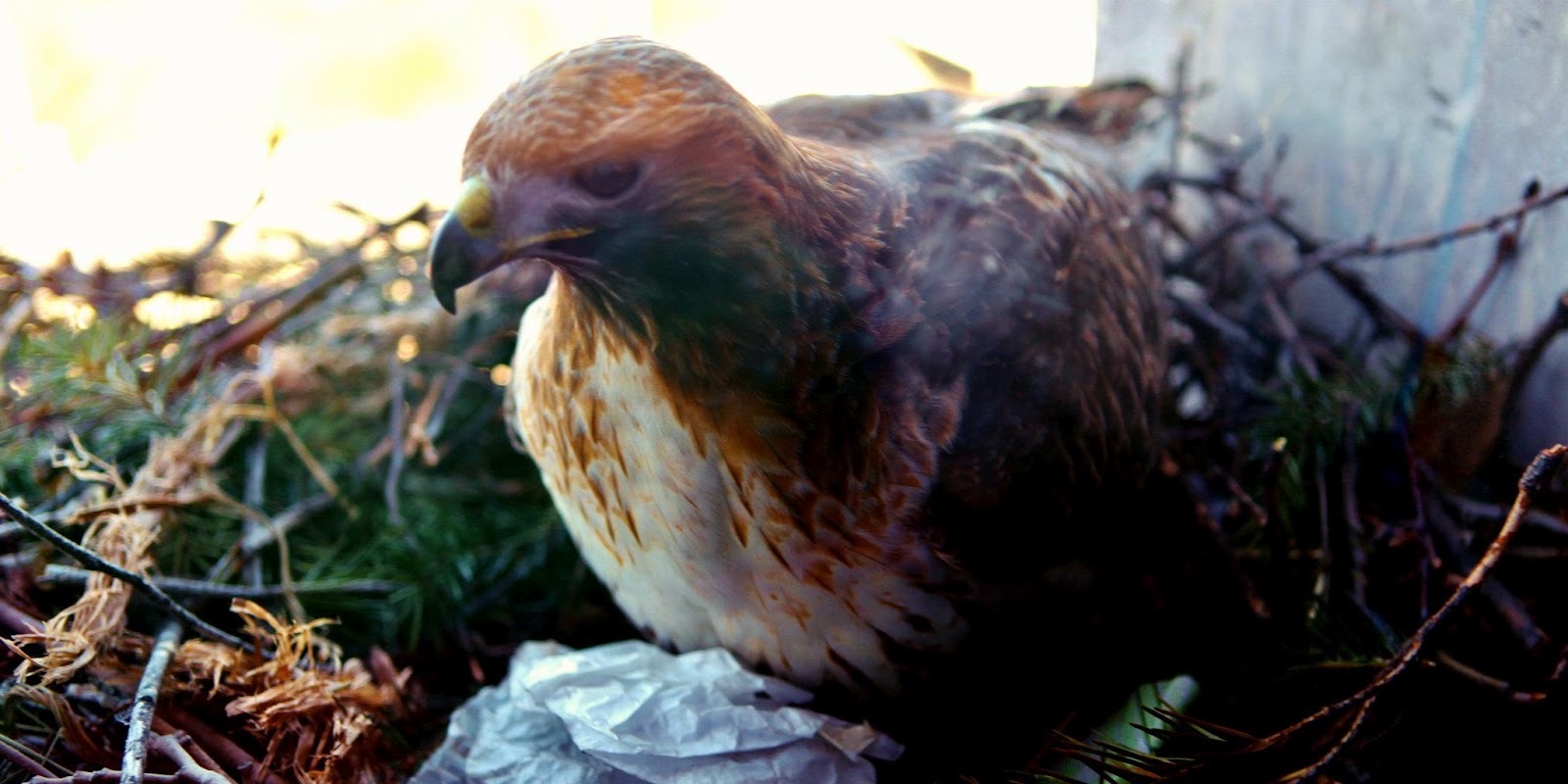
Sunday, April 22, 2012

All is well with the two new eyasses

The newly hatched eyasses' first day yesterday was sunny and warm.  It did not take long for them to figure out where to get food!

         Screen cap - Marge Goodman

The Franklin Institute hawks are now such experienced parents that they had food already in the pantry ready for this first feeding.  Both eyasses fed eagerly and knew instinctively to stretch up to mom.

Today, the weather changed dramatically to gray skies and a chilly rain.  Daylight revealed a definite pip in the third egg.

           Screen cap - Carolyn Sutton   


The tiercel soon arrived with fresh food - probably a vole.  There was still a rat carcass in the twigs over to the edge of the nest.


He dragged the rat over to the vole as if to present his mate with the complete range of tasty offerings...


... and tore off a sample to tempt her.


Then followed one of the tenderest moments one can witness in hawkdom as he carefully fed her tiny morsels until she was no longer hungry.


Eventually she stood, and up popped the eyasses ready for a morning snack, with their sibling egg sitting calmly to the side.


Mom pulled off bits of rat and fed them to the eager eyasses as dad looked on proudly.


When they were sated, she started to settle down over them, leaving plenty of food on reserve stacked around the nest.


The tiercel left, no doubt to bring in yet more food.  He is a hunting machine, and takes very seriously his role as sole provider for the family.  The formel settled right down to keep the eyasses snug against the increasingly wet and cold day.  This is essential as the eyasses cannot yet regulate their body temperature to stay warm without her protection.


By mid-day, it was time to eat again.


Though the pip on the egg did not seem bigger, there was a noticeable crack alongside it.


 At around 1PM, when mom stood up, the pip was definitely much larger, so the third eyass may appear later today.


One of the eyasses was ready to eat again, while its sib slept on.  The white bar across the hawk is a reflection from the screen inside the Franklin Institute placed across the window for hawk privacy.


As mom fed the eyasses, she somehow dislodged a long twig which fell across one eyass' neck, and pinned the other one's body down.  Both of them struggled to try to get out from under it.  This wonderful mother immediately saw the problem....


... carefully stepped around the eyasses, reached down to pick up the twig in her beak..


... and tucked it down at the back of the nest against the window.


It is truly a privilege to watch these incredible hawk parents write the textbook on how to raise eyasses.  Let's hope this family will soon be complete.

Saturday, April 21, 2012

Two eggs have hatched!

At some point during last night, the first egg hatched and at daybreak, here was this exciting view of the first eyass (baby hawk) out of the egg with the half-shells on either side, and a clear pip and crack in the second egg.

         Screen cap - Carolyn Sutton


A little later as the sun came up, the eyass has moved away from its shel, and the second egg is well on the way to hatching.

         Screen cap - Scott Kemper

At about 10:45 AM, the formel stood up, and there was the second eyass pushing out of its shell with mom watching intently.


Here are some Youtube videos recorded by WillowOaksYorkies of both hatches.  Many thanks to Willow for capturing these exciting events from the Franklin Institute camera.

In this first video, when mom stands up we can see the newly hatched eyass, and the second egg starting to crack.  She settles back down at 1.44, then at about 4.25 she does what almost appears to be a somersault as she checks what's happening beneath her, and we can definitely see the second egg starting to crack open.


Now we can see the formel inspecting what's happening down below as the eyass waves its head from under the formel's chest.  At 1.55 she moves away a little and we can see a huge pip in the second egg.  An ad comes on at 3.14 and no more hawks.


In this video, both eyasses are moving actively and looking strong.  Mom returns at 3.20 and checks them out carefully and settles down.  Newly hatched eyasses do not need to be fed immediately.  They can go for up to 24 hours before needing the first feeding. 


The tiercel, wonderful and experienced dad that he is, checks in on his eyasses, and seems uncertain how to settle down onto them.


All together, this has been a marvelous morning with the Franklin Institute hawks as they once again demonstrate their superb parenting skills and experience.  Could there be a better start to the Earth Day weekend as we wait for #3 to arrive and complete the 2012 family.

Many thanks again to WillowOaksYorkies for the great videos.


Friday, April 20, 2012

And the wait continues for the eggs to hatch

This has been a week of patient waiting and watching for that first pip.  Every time a hawk stands up, we anxiously gaze at the eggs... those very white eggs.


Dad gazes too... as if he can hardly believe that nothing has happened yet.


If watching paint dry requires patience, try watching eggs incubate!  Just about the biggest excitement is the changing of the guard...


 ... especially if the tiercel brings his specialty gift of fresh leaves for the nest.


This always accomplishes his desired result of getting the formel to stand up so he can nestle back on his beloved eggs.


But as much as the tiercel loves to take his turn on the eggs, he is like many nervous dads when left alone, restlessly wondering when his mate will return...


... and then dutifully settling back on the eggs when she is nowhere in sight.


Just to change things up a bit, he sometimes brings in a snack - in this case a half-eaten rat for breakfast in bed for mom.


She seemed quite oblivious to this yummy offering right under her beak, and it sat there for several hours yesterday.  So he went back to what he knew would work - fresh greens again - and that did the trick.  She stood up...


... walked right over to that rat, picked it up, tail dangling, and flew off, no doubt to have some me-time over lunch.


.He watched her go...


... then fussed with his leaves, breaking the branch in half, and rearranged the pieces to his liking...


... before settling down on the eggs.


And to keep things interesting, he turned to face the other way.


And so it continues as we inevitably get closer to when the first pip will appear on one of those eggs, and hatching will be underway.

Meanwhile, I'd like to share some wonderful images of the hawks taken from inside the Board Room by Darryl Moran, official photographer for the Franklin Institute.  Darryl took these pictures on March 14 when the first egg was laid.

I just discovered that if you click on any of these blog images, you can see an enlarged version, and even more gorgeous details.


This illustrates why it's impossible from the street below to see a hawk sitting down on the eggs.


You really get a sense of the depth of the nest bowl in these images.


Saturday, April 14, 2012

Waiting for the first "pip"

If the weather folks are to be believed, this gorgeous Saturday morning in Philadelphia is the start of a spectacular few days.  The spring flowers are loving it -- the wisteria blooms on the porch of my house have never been lovelier or denser.


At the Franklin Institute hawk nest, incubation continues.  The parent hawks are on a really smooth routine, each taking turns sitting on the eggs.

Dad always looks a bit scrunched up and anxious.  His wings stay clenched on his back ...


... unlike the formel who lets her wings droop down her sides.


When the hawks switch off, the new "sitter" rolls the eggs.  Here's the formel getting the eggs just in the right spot ...


... to get them positioned on her brood patch, then she settles back down on them


She keeps an attentive eye on what is happening on the always-busy streetscape below.  Right now, the feather color is really smooth on her head...


... compared to dad's slightly streaked head


 Occasionally, the eggs are hawkless, and we can do a quick check to see if a pip has appeared yet on any of them.


A pip or tiny hole in the egg is the first indication that hatching is underway.  John Blakeman gave us some great information on pipping and hatching back in 2010, so let's do a review!  I added a couple of images by way of explanation, but these are not of hawk eggs or eyasses.
From John Blakeman:

"We all expect just a wonderful experience as we witness the hatching, with the first indication being that pipping has begun. Pipping is when the little eyass inside the egg begins to thrust its beak out at the end of the egg and will create a small crack. That’s pipping, the cracking of the egg, and it’s very important.
It’s done by the "egg tooth," a slight temporary projection on the top of the beak.


With a rounded bill, it would be otherwise very hard for the little eyass to poke any sort of hole through the egg shell. But the slightly pointed egg tooth will allow the weak eyass to accomplish this.
That will be the first sign of hatching. Someone will see the slightest crack on the end of an egg. Everyone will get understandably excited.

But then disappointment will set in. We would all expect the little eyass to continue to break open the entire egg after the first pipping and step right out into the world. But it doesn’t (and shouldn’t) happen that way.
After pipping, the little eyass stops pecking at the egg shell and remains rather quiet. (Wish we had a microphone buried in the nest so we could hear all of this.) The eyass is quiet for two reasons. First, she has used a lot of energy punching her beak out at the egg, so she tires of all this activity. But more importantly, her lungs are not ready to be exposed quickly to open, dry air.

For most of a month, her lungs have been filled with fluids, and she’s been breathing very moderately through simple air diffusion into her body tissues. But in the last week or so, things start drying out inside the egg and slowly her lungs will get filled with the gases in the end of the shell. It’s still 100% humidity in there, and all is well.
But after pipping, dry air from the outside begins to replace the moist air inside the egg. If that happens too fast because the pipping creates an overly opening, the lungs dry out too rapidly and the eyass simply dies from non-functioning lungs.
So, we must be patient when we see the first pipping. It could be a day or longer before the eyass finally emerges. There is no need for the little hawk to get out of the egg. She’s happy with the humid air in there, while her lungs start to adjust to cold, dry air on the outside.
At the end, when she’s ready, the eyass will make some final thrusts with her head and create an opening big enough from which to emerge. She will hardly be able to hold up her head, and she may not eat or be fed for up to a day. It can be so frustrating to see the little hawk lying down in the nest, without the energy to even stand up and open its mouth for the tiny tidbits of food the formel will offer when the eyass first takes this "I’m hungry" posture.
We just have to wait for all of this to happen. To rush any of this would be to endanger the health of the eyass. In captive breeding of raptors, falconers know that they must never help the little eyass get out of the egg too soon. The eyass instinctively knows what to do, and when to do it. We must merely stand back and watch this marvelous sequence of behaviors.
And we need to continue to thank The Franklin Institute for allowing us to watch all of this. We raptor biologists can never see any of this when aiming our spotting scopes at wild nests. It’s all way up there in a tree, and we can see only the haggards coming and going. Here at the Franklin Institute, everyone gets to look right down inside the nest and see it all. And once again, we should get to see some pipping and then hatching, followed by the formel feeding the newly-emerged downy eyasses.
But I offer a sobering thought, one that we must consider and be gravely ready to confront. As good as these haggards have been, there can be no guarantee that all three eggs will pip, hatch, or have their eyasses grow up and fledge. The stark reality is that one or more eyasses may fail to hatch, or fail to thrive and die.
Eyass deaths are rather common. It’s just part of nature. Should an egg fail to hatch, or a little eyass dies, we must accept this as a natural part of the entire process.
Now, let’s sit back and wait, with our eyes glued to the screen. Let new red-tail eyasses grace the skies of Philadelphia once again!"
–John Blakeman